Youngest son Stephen and I have returned
from our first trip together in some time.
Stephen dislikes sailing in Surprise
with her high angle of heel, and tendency to pound and occasionally to capsize
(albeit safely), and he does not always choose to crew together with his older
brother. So when the opportunity
unexpectedly arose to sail together--just the two of us--I quickly abandoned my
plan to take Surprise on a simple
overnight from Fall River to nearby Hog Island, and began provisioning the
bigger, more stable Beatrice Ann. A more seaworthy boat immediately opened our
horizon, and I wondered if this would be the time to sail from Warwick to
Jamestown, which I had reconnoitered but never landed on. On hearing this, Beatrice wondered if she
could meet us there. That sealed it: an
adventure complete with a nice restaurant meal with my wife was in the offing--an
adventure of the very best sort.

As always, preparations were prolonged. In the end, I loaded way too much food Bea
bought with Stephen, tied everything down tight, and pulled out of the driveway
in the middle of the night.
Yup.
I never have been able to get the timely departure thing down. Boat buried under stuff in the garage, that
sort of thing. Further delays at the
ramp meant we pushed off at exactly midnight.
I sometimes reflect that we could
ready the boat, then leave it in the driveway ready to go next morning and sleep
in our own comfy beds. But as always I
wanted to be in the water, to have made a beginning--never mind the time wasted
in a late start next morning after too little sleep.
The tide was low and the shoals
extensive, the channel was narrow and the fresh wind foul, so that we ran
aground more than once despite my best efforts, managing the two-mile trip to
our first anchorage in a little less than two hours. Stephen lasted less than half of it before
crawling into his sleeping bag fully clothed and leaving me to carry on
alone. I kept toasty in the cool wind in ski pants, wool sweater, fleece and shell. We snugged up against the north
shore of Prudence Island, dropped anchor in the lee, left the stern light
burning in lieu of a forgotten anchor light, and I slept.
Stephen is trying not to miss the dogs.
Our anchorage.
Rising was late, and breakfast
disappointing to Stephen, since I seemed unaccountably to have forgotten the
oatmeal. We were off at 10:30am under
all plain sail in a freshening wind. Stephen
steered for awhile before the building wind and waves got too scary. We passed Quonset at about 11am. Lunch was snacks--I was too busy spilling
wind and trying to keep Bea Ann on
her feet to make sandwiches. We detoured
slightly around the east side of Gould Island when a powerboat rushed headlong
up to us to inform us we were in danger of running into a "submerged
vehicle" deployed somewhere ahead.
Quonset, with a big ship in port.
Glad I had my eyes open--didn't notice Halfway Rock on the chart until afterwards.
The wind built well beyond the
predicted 5-10mph, and we eventually had to drop anchor near Middletown to
shift masts, reducing sail to mizzen only.
The boat rode much easier afterward.
We sailed under the Newport Bridge's center span--its vertical clearance
of 194 feet slight overkill for our 25
foot masts. We got too close to one pier
before being able to read the "restricted area" notice that warned us
not to approach closer than 25 yards.
Beatrice Ann anchored in Jamestown Harbor.
As we approached the beach in
Jamestown Harbor, we saw Bea waving from shore.
I decided to try to drop the anchor close enough to shore for the rode
to reach as we beached. Before going up
to the foredeck, I released the rudder downhaul and gave Stephen the tiller
with instructions to free the sheets on my signal. The boat touched lightly with 25 feet of rode
still on deck--perfect!
After Stephen went ashore, I pushed
off and let the wind take us. We were
anchored in the lee of the town docks and adjacent to the (busy) main
road. I put electronics out of sight in
the cabin, tossed shoes and dry underwear into the kayak, and paddled back to
the beach. Ten minutes in the public
restroom with my stuff and the clean pants Bea brought from home, I was ready
to walk unembarrassed into a casual restaurant.
Bea's choice was Chopmist Charlie's--a good place: not fancy, not too expensive,
and with character.
A little wine makes things better.
Stephen enjoyed being an "only child" for a change.
I realized too late I'd forgotten to comb my hair. --should have been embarrassed after all!
The food was good too: fried clams for
Stephen, steamers for me, and haddock for Bea, though of course we all swapped
around. A bottle of chardonnay for the
parents and soda for the son. Stephen
admired the decor of mounted fish so treated as to appear plastic--though a
plaque under each detailed the circumstances of the catch. Desserts of tiramisu, brownie sundae, and
bumble berry pie al la mode (guess who ordered what) brought us near to
sunset. We walked a block or two, admired
the way the setting sun lit up the Newport Bridge, and then it was time to go
back aboard to settle in for the night while we could still see--always a good
idea if you can manage it.
The Newport Bridge catches the setting sun.
I paddled back out to the boat,
managed to get the starboard deck plate open and get at the spare rode while
still seated in the kayak, and then paid out rode as I paddled back to shore. Even near high tide there was just enough
scope on the anchor that I could pull the stern of the boat close enough to the
beach for Stephen to get aboard in shin-deep water. Recovering the spare rode and cleating the
kayak's painter, I kissed Bea and stepped aboard, again letting the wind swing
us out, parallel to shore. We settled
into our sleeping bags and passed a HarryPotter book back and forth for two
chapters, then went to sleep at the sane hour of about 9pm.
The next morning we ate rice pudding
and poptarts (toasted in a saucepan) for breakfast. Of course orange juice and coffee. Only then did I discover the oatmeal I'd
squirreled away in the back of the locker; that sure would have been welcome
when we woke, sleep-deprived, that first morning!
Winds were light to begin; I judged it
prudent to move the mizzen back into place and fly full sail for the start: if
it blew too hard later we could reef the conventional way, since sail shape was
less important going down the wind. We
consulted on our absolute deadline: Stephen's soccer practice that afternoon at
5:30. Factoring in the 11 nautical miles
between us and the ramp, recovering and readying the boat for the road, and the
hour plus drive, I figured we could have one last adventure if we proceeded
south around Conanicut Island, passing Beavertail Light at the mouth of the bay,
and going up the West Passage through Dutch Harbor, none of which Stephen had
ever seen.
The "Isolate Tower" on the Dumplings.
Stephen takes the air upon the foredeck.
I pulled up the anchor as Stephen
sailed us out, then we switched, and Stephen went onto the foredeck to take the
air. It was good to see him out and
about, after memories of sailing alone hour upon hour while he and his brother
read in the cabin. We passed amazing
houses as we sailed past the Dumplings and around Bull Point on our way south:
one perched on a high rock with no obvious access to the shore, others on
cliffs where the owners could see the sea, but not easily reach it. We looked into Mackerel Cove, which nearly
splits the island in two but provides no shelter from prevailing winds. We rounded Beavertail at 10:10 with the open
Atlantic on our port side, then turned north as the wind built even higher than
it had been the day before. Stephen did
some of the sailing but sometimes passed the tiller to me when the surfing
began to make him nervous.
Beavertail Light.
Stephen at the helm.
A pier of the mighty Jamestown Bridge, an abandoned light close by.
I decided to heave-to in Dutch Harbor
to reef the main. (Reefing the mizzen
would have been a trick, since the boat won't lie head-to-wind while I do
it.) Once done, we headed north again,
surfing the waves at speeds sometimes over 6 knots, and once touching 9! (I learned later that winds at Quonset were
clocked at a steady 20mph that same afternoon.)
These high speeds turned out to be far
too high for the kayak, which flipped over twice. Each time, it filled with water that was
time-consuming and difficult to bail, and set us back on our timetable. The second time we watched the break-down
paddle drift away as I bailed, while Stephen tried to keep the pieces in sight. By sheer luck we were able to recover half of
it. Only afterward did I realize we had
also lost the kayak's rudder (a recent homemade experiment) and the spare rode
I'd used to pull the boat in the night before.
These had not been seen since the first capsize, back in Dutch
Harbor. At my wits' end, I decided to
lenthen the tow rope, hoping the delay in reaction to the boat's movements
would be enough to keep the kayak upright.
We had no further trouble after that.
We sailed under the Jamestown Bridge
and quickly up the bay, landing back at the ramp at 2:10pm. We were lucky to be a litle early, since a
ramp axle-deep in sand and then a flat tire on the van delayed us, so that we
arrived at home just in time for Stephen to don his shin guards and cleats for
soccer practice.
 The bending.
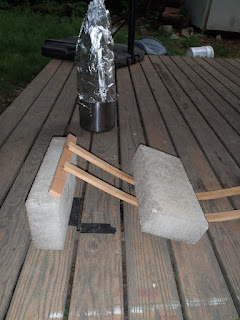 You can just make out the are split if you look at the left ends. The steaming apparatus (minus the suspending rope and the pressurized gasoline stove that went underneath) is in the background.