Sunday, June 10, 2012

Frame finished, time for a pause

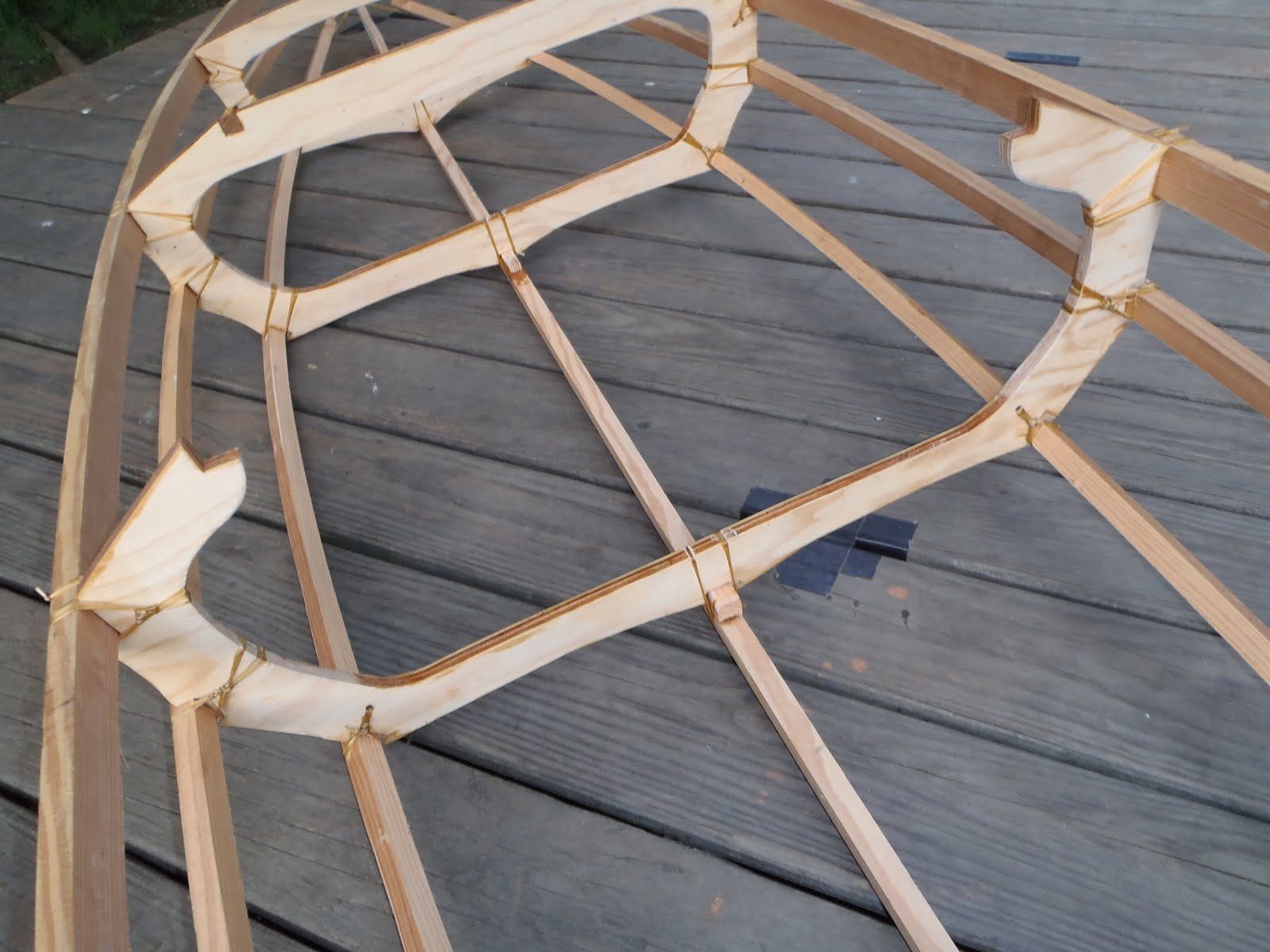
Installed the cockpit carlins last week (glued and screwed at the front, lashed in the middle and back), installed the foredeck beam, added a "top seat", and oiled the frame.  Before the carlins were finally lashed, I glued the split ends closed with wood glue, and then covered the remaining gap with a bit of leftover epoxy, so water wouldn't hide there.  The only thing left to do before skinning is to put in floorboards.  The top seat is an idea I saw in another designer's boats, and seems to provide a place to rest on the way in or out of the boat.  I have doubts that the boat would be stable with weight up so high, but the other designer (Jeff Horton of Kudzu Craft) builds his boats narrower than Mr. Gentry does, so it's worth a try.  I have certainly embarassed myself repeatedly with my attempts in getting out of my little store-bought kayak!  The oil referred to is tung oil, several coats of which are rubbed into the wood of stringers and frames and polymerize as it dries, forming a moderate barrier to water.  It darkens the wood slightly, but is otherwise almost invisible.

The carlins are visible converging to almost meet as they connect to the second frame.

Where the carlins meet the frame, they are held in place by stainless screws and triangular "knees" glued with epoxy.

The floorboards will be something of an experiment: the design calls for a floor of slats or solid lumber to run the length of the cockpit resting atop the frames and lashed in place.  I dislike sitting with my legs straight out, and the fact that I had to add spacer blocks between frames and keel to make the keel straight gave me an idea.  Perhaps I could make floorboards atop the frames for the back half of the cockpit, but lash slats UNDER the frames in the front half.  that way my feet would rest several inches lower than my seat.  This is reflected in the floorboards shown (not yet lashed in): they stop at the center frame, rather than running full length.  The slats for the forward end will be salvaged from a piece of Ikea furniture that did not last long.  The Ikea slats are 7-ply, and appear to be fairly water resistant, since a few days in the rain barrel have made no difference to them.  (These floor slats are not shown in any photo.)  Finally, I will use a few pieces of 1x1 doug fir (same wood and about the same dimensions as the boat stringers) to make floors for the compartments under the deck in front of and behind the cockpit.  This is storage volume, and while it isn't big enough to store a sleeping bag or tent, it could hold useful amounts of stuff--say for a nice picnic.  I don't want stuff stored there to push against the cloth, hence the need for floor slats.

The top seat is lashed in place atop the frame, while the seat floorboards are resting in their places inside the cockpit.


The curved carlins define the shape of the cockpit.  When I sit on the floorboards with my back against the aft frame, me feet just reach the front of the cockpit, which is about four feet altogether.

None of these pieces are going to go in for awhile.  I've decided that a frame at this stage is too useful as a teaching tool, so I will go no further with the build now.  I plan to use the frame as it is to show the kids this summer what they are aiming for, how lashings should look, and so forth.  About halfway through the July program I will add the floorboards and skin the kayak--I may even have the kids help so they do a better job on the larger kayak they will be working on.

Saturday, June 9, 2012

First Leg: New Bedford to Hyannis

This is an ambitious trip for a single day, including as it does a beat from New Bedford Harbor down the Acushnet River, 12NM across Buzzards Bay, negotiating the tricky currents of Woods Hole, and then a long sail down to Hyannis with potential trouble from the currents in Vineyard Sound and Nantucket Sound.  I would not have considered it a one-day trip at all, except that I did exactly that about a year ago.  Granted the conditions were just about ideal, so I will have to build-in a stopping point in case--this time--they're not.  This is also the part of the trip in which a whole string of tides and currents have to work out just right.

Departing New Bedford Harbor, with the usual sw prevailing wind, requires an ebbing tide.  The hurricane barrier that makes the harbor such a safe place also makes it a bear to get in and out of without a motor.  The barrier effectively blocks the wind as you approach the entrance, so even if my boat pointed higher than she does, she'd still be at the mercy of the tide in the end.  It doesn't matter what stage of tide I leave at, but it needs to be ebbing.  If I can't get a good ebb tide pretty early in the morning, I'll have to put the boat in the water the night before and find shelter outside the harbor for a night--not an attractive possibility.  Once out of the harbor, getting down the Acushnet River into the open Bay is usually a beat, but it's fairly routine, if not very fast. 

Once out in Buzzards Bay I have about 12NM to sail (perhaps a 3 hour trip) to get to Woods Hole.  Woods Hole is one of three "holes" that perforate the Elizabeth Islands.  (These islands are destinations in their own right, but on this trip they are simply obstacles.)  Woods Hole is the largest of these passages, and the  most direct for my purpose, but also the trickiest, with many rocks and reefs and strong currents.  Even if the wind were favorable, the currents are so fierce that I have found it hopeless to oppose them.  So I must have a favorable current to get through Woods Hole.  In case the passage among rocks and reefs and tidal waves doesn't get my adrenaline going, throw in constant ferry traffic between Woods Hole and the islands; some parts of the passage seem barely wide enough for a big ferry by itself, let alone a mammoth ferry and little ol' me!  Here, then, is the trickiest line-up: falling tide in New Bedford Harbor in the morning, a favorable wind to Woods Hole, and then favorable currents when I want to pass through in the early afternoon.

[In the event I am delayed getting through Woods Hole, I will still try to get though the same day, and will then head for Vineyard Haven in Martha's Vineyard.  VH has a fine harbor that I am familiar with, and I know just where to drop the hook to be a stone's throw from a public shore but out of the way of other boaters.  If this happens, the trip will automatically become one day longer!  In that case, I might just make a virture of necessity by going ashore for a nice meal at the Black Dog Tavern or somewhere.]

Once through Woods Hole, I have a fairly straight shot to Hyannis.  If the currents in the Sounds are against me, they can take a full knot or more of my speed.  And if winds are light, the trip could be nearly endless.  (I have twice found myself sailing backward  for hours at a time in Vineyard Sound due to weak winds and opposing currents--and there was nothing I could do about it in either case!)

The entrance to Hyannis was difficult to see when I sailed there last year, but gps will make it a snap.  Ideally, I will swing in to anchor behind Dunbar Point before full dark.  Hyannis is a neat little town to wander in, but having done so before, for this trip I will likely waste no time even going ashore.

This whole leg is about 34NM as the powerboat flies, but of course it will be longer for me!


From New Bedford, outside Cape Cod, to Boston: Planning

This would be the biggest trip ever, and the longest time afloat in several years.  It would also involve the greatest distance in open water and away from safe harbors.  It would connect several dots I have made over the years--a five-day trip to Provicetown from Pymouth, and several trips among the Boston Harbor Islands--to some of my regular stomping grounds of New Bedford, Buzzards Bay and the Elizabeth Islands, and Martha's Vineyard.  So far, the trip is not definite, since it involves disappearing with one of my boys for at least 4-6 days during a fairly busy time of year.  But I'm going to do enough of the planning so that, should opportunity and weather coincide, I will have it together, and be able to go at fairly short notice.

This blog is mostly the stories of boat trips I have taken, written after the fact.  But since planning is half the fun, I'm going to let you in on that, too, over a period of days.

First, some givens.  I sail a home-built Core Sound 20 cat ketch named Beatrice Ann, designed as an open-cockpit, moderately high-peformance sailboat.  Because I like to sail for several days at a time, and because the boat throws a fair amount of spray, I eventually built-on a small cabin.  She is more comfortable now, but--due partly to a wonky hull (it was my first ever build) and the added weight of cabin and gear--she is high-peformance no longer, and does not point well.  She is quite stable and will not likely turtle in a knockdown, but will not self-right from a capsize, either.  As a sailor, I seem to be perpetually mediocre.  As a navigator, I can't find my a__ with both hands unless one of them is holding a gps.  The Beatrice Ann has no motor--not so much because I'm a purist as because I can't afford one.  My two younger sons sometimes crew, but they are far from competent enough to sail alone.  I am happy to teach them, but they don't have the drive to learn that I did at their ages.  All of these facts make me a rather cautious adventurer.  In the days to follow, I will consider each leg of the journey ahead and imagine the challenges and joys that might await.

Tuesday, May 29, 2012

Steam-bending the carlins

Over the last couple of days I put an hour or so into sanding the frame.  Ticklish work: sanding each stringer on all four sides without touching the lashings--which would instantly fray.  (When I do this with the kids, we will sand the stringers BEFORE we build--in fact, teams of two can each work on their stringer while one team cuts out their frame with the jigsaw and a second team watches to learn how it's done.  Phew! -bottle-neck relieved!

A few more things to complete the frame and prepare to skin it:
Bend and install cockpit carlins and deck beam.
Resaw strong-back and make floor boards from it.
Oil frame.

Today I steam-bent the carlins--a skill I'd never really used before.  The closest to steam-bending wood was pouring boiling water on gunwales to enable them to make the curve of the deck.  This was a bit more official: the carlins (already split for two feet to make bending easier) were suspended in a foil cone over a pot of boiling water for at least half an hour.  Then I rushed them (the pliability doesn't last longout to where I'd set up cinderblocks.  The ends rested atop cinder blocks and a third weighed down the middle.  When I'm done writing this, I'll take them into the garage and see how they fit!

The bending.

You can just make out the are split if you look at the left ends.  The steaming apparatus (minus the suspending rope and the pressurized gasoline stove that went underneath) is in the background.

Sunday, May 27, 2012

Building a Chuckanut 12 skin-on-frame kayak


Last spring, in preparing for my summer boat-building day camp at St. Andrew's Episcopal Church, I built a small paddling boat to test my ideas and get a feel for how it might work with kids.  The result was very heavy and clunky, and taught me how NOT to build a simple hull.  This year I was invited to give the program again but with middle-school youth, so I decided a more sophisticated boat was in order.

One of the boats built in the St. Andrew's Summer program.

I've become interested in the modern versions of skin-on-frame boats that were originally developed by the peoples of the far north, such as those known variously as Eskimos, Innuit, Aleut and Yupik.  Their seal-skin-covered boats, evolved in an environment where wood was incredibly scarce, ended up with hulls that were seaworthy yet very light--superior in many ways to those of the Europeans who first encountered them a couple of centuries ago.  The modern versions of these kayaks take full advantage of the properties of plywood for shaping the hull, and the durability and ease of use of nylon or polyester cloth for covering.  They have developed a reputation for lightness, durability, and--perhaps most importantly-- relatively fast and inexpensive construction. 

I have already built a two-man kayak that is quite good-looking and functional, yet--even though it is made mostly of expensive and light-weight 3/16-inch plywood--is still a bit heavy to for loading single-handed on the minivan roof rack.

 Serendipity, my B&B Yachts-designed Birder2, at her christening.

A skin-on-frame kayak involves (I thought) less use of dangerous edge tools and has jobs such as cutting out frames and tying lashings, that could occupy a fair-sized group of kids simultaneously--important values for my program.  Of course, I would have to build one first so I could program and organize the build into the time available and teach kids the necessary skills; and that--wouldn't you know--would give me a kayak of my own!  Several "professional amateur" designers offer skin-on-frame designs.  After settling on Dave Gentry's Chuckanut kayak, I wrote to him about the St. Andrew's summer camp program--he promptly donated a set of plans, even paying the postage!  (I bought the plans for the one-man kayak I am building for myself; Dave then donated the plans for a two-man kayak the kids will build.)

Progress so far--
I have been working rather slowly and fitfully, having cut out the frames with a jigsaw and ripped the long stringers on a table saw months ago.  I only just finished tying the lashings that make frames and stringers into a stiff and stable whole.  I still have to install the carlins that will define the cockpit edge, and a deck beam that will provide a stable place to attach things.  Once these are done I can "skin" the boat with heat-shrink polyester, shrink it taut with a hot iron, and paint the fabric to make it waterproof.  All that must happen in the next few weeks to be ready for the program, which begins in July.  On the other hand, I may put off skinning the boat until the program is well under way in mid-July--that way the kids can see the critical steps and goals before they have to perform them.

The end frames and keel begin attached to a "strong-back" of 2X4 pine to keep everything aligned in the beginning.

Figure-eight and over-hand knots secure the end of the "artificial sinew" used to tie stringers into notches in the frames.

A series of wraps around the frame and stringers, tightened by wraps around the wraps, make a strong but slightly flexible joint.

This open-ended frame makes for a generously-sized cockpit.

Stems are secured to the gunwales, keel, and other stringers by a combination of screws, epoxy, and lashings.

The frame, made of seven douglas fir stringers lashed to five plywood frames, is complete except for cockpit edges and a deck beam.

Mid-May on Lake Nippenicket

Got out in the yellow kayak a  couple of Fridays ago for an hour-long paddle around the east side of Nippenicket with my camera, photographing a riot of red-winged blackbirds and the landscape and flowers.  Collected a couple of plant specimens to ID, too.  Thinking about the idea of a little book: Nippenicket Through the Year.  The next day I and the boys spent two hours on the western shore and got lots more photos.  I also got a bad sunburn on my legs--especially my shins.  (Next time I will have something light-proof to cover them with!  -and sunscreen!)  This time I got some good photos of a great blue heron, among the hundred or so I took.  I have begun to catch on to the fact that my camera can't compete with the slrs with their big telephoto lenses: my camera takes pretty good amateur shots, but they would look very Mickey Mouse in a book.  Maybe my text could make up for that... 

Can you find both red-winged blackbirds?

Here is one family that knows how to enjoy the pond.


Kids out for a walk with Mom.

Yellow irises in bloom.


Royal fern (Osmunda regalis).

Trevor is entranced by the red-winged blackbirds.

Yellow water lily (Nuphar advena) and the insectivorous bladderwort (Utricularia inflata) in bloom.


A great blue heron...


...takes flight.

A willow (Salix cordata) in bloom.

Almost home.

Tuesday, April 24, 2012

Journey to Jamestown


          Youngest son Stephen and I have returned from our first trip together in some time.  Stephen dislikes sailing in Surprise with her high angle of heel, and tendency to pound and occasionally to capsize (albeit safely), and he does not always choose to crew together with his older brother.  So when the opportunity unexpectedly arose to sail together--just the two of us--I quickly abandoned my plan to take Surprise on a simple overnight from Fall River to nearby Hog Island, and began provisioning the bigger, more stable Beatrice Ann.  A more seaworthy boat immediately opened our horizon, and I wondered if this would be the time to sail from Warwick to Jamestown, which I had reconnoitered but never landed on.  On hearing this, Beatrice wondered if she could meet us there.  That sealed it: an adventure complete with a nice restaurant meal with my wife was in the offing--an adventure of the very best sort.

          As always, preparations were prolonged.  In the end, I loaded way too much food Bea bought with Stephen, tied everything down tight, and pulled out of the driveway in the middle of the night.

          Yup.  I never have been able to get the timely departure thing down.  Boat buried under stuff in the garage, that sort of thing.  Further delays at the ramp meant we pushed off at exactly midnight.

          I sometimes reflect that we could ready the boat, then leave it in the driveway ready to go next morning and sleep in our own comfy beds.  But as always I wanted to be in the water, to have made a beginning--never mind the time wasted in a late start next morning after too little sleep.

          The tide was low and the shoals extensive, the channel was narrow and the fresh wind foul, so that we ran aground more than once despite my best efforts, managing the two-mile trip to our first anchorage in a little less than two hours.  Stephen lasted less than half of it before crawling into his sleeping bag fully clothed and leaving me to carry on alone.  I kept toasty in the cool wind in ski pants, wool sweater, fleece and shell.  We snugged up against the north shore of Prudence Island, dropped anchor in the lee, left the stern light burning in lieu of a forgotten anchor light, and I slept.

Stephen is trying not to miss the dogs.

Our anchorage.

          Rising was late, and breakfast disappointing to Stephen, since I seemed unaccountably to have forgotten the oatmeal.  We were off at 10:30am under all plain sail in a freshening wind.  Stephen steered for awhile before the building wind and waves got too scary.  We passed Quonset at about 11am.  Lunch was snacks--I was too busy spilling wind and trying to keep Bea Ann on her feet to make sandwiches.  We detoured slightly around the east side of Gould Island when a powerboat rushed headlong up to us to inform us we were in danger of running into a "submerged vehicle" deployed somewhere ahead. 

Quonset, with a big ship in port.

Glad I had my eyes open--didn't notice Halfway Rock on the chart until afterwards.

         The wind built well beyond the predicted 5-10mph, and we eventually had to drop anchor near Middletown to shift masts, reducing sail to mizzen only.  The boat rode much easier afterward.  We sailed under the Newport Bridge's center span--its vertical clearance of  194 feet slight overkill for our 25 foot masts.  We got too close to one pier before being able to read the "restricted area" notice that warned us not to approach closer than 25 yards.   


Beatrice Ann anchored in Jamestown Harbor.

         As we approached the beach in Jamestown Harbor, we saw Bea waving from shore.  I decided to try to drop the anchor close enough to shore for the rode to reach as we beached.  Before going up to the foredeck, I released the rudder downhaul and gave Stephen the tiller with instructions to free the sheets on my signal.  The boat touched lightly with 25 feet of rode still on deck--perfect!

          After Stephen went ashore, I pushed off and let the wind take us.  We were anchored in the lee of the town docks and adjacent to the (busy) main road.  I put electronics out of sight in the cabin, tossed shoes and dry underwear into the kayak, and paddled back to the beach.  Ten minutes in the public restroom with my stuff and the clean pants Bea brought from home, I was ready to walk unembarrassed into a casual restaurant.  Bea's choice was Chopmist Charlie's--a good place: not fancy, not too expensive, and with character. 

A little wine makes things better.

Stephen enjoyed being an "only child" for a change.

I realized too late I'd forgotten to comb my hair.  --should have been embarrassed after all!

          The food was good too: fried clams for Stephen, steamers for me, and haddock for Bea, though of course we all swapped around.  A bottle of chardonnay for the parents and soda for the son.  Stephen admired the decor of mounted fish so treated as to appear plastic--though a plaque under each detailed the circumstances of the catch.  Desserts of tiramisu, brownie sundae, and bumble berry pie al la mode (guess who ordered what) brought us near to sunset.  We walked a block or two, admired the way the setting sun lit up the Newport Bridge, and then it was time to go back aboard to settle in for the night while we could still see--always a good idea if you can manage it.

The Newport Bridge catches the setting sun.

          I paddled back out to the boat, managed to get the starboard deck plate open and get at the spare rode while still seated in the kayak, and then paid out rode as I paddled back to shore.  Even near high tide there was just enough scope on the anchor that I could pull the stern of the boat close enough to the beach for Stephen to get aboard in shin-deep water.  Recovering the spare rode and cleating the kayak's painter, I kissed Bea and stepped aboard, again letting the wind swing us out, parallel to shore.  We settled into our sleeping bags and passed a HarryPotter book back and forth for two chapters, then went to sleep at the sane hour of about 9pm.

          The next morning we ate rice pudding and poptarts (toasted in a saucepan) for breakfast.  Of course orange juice and coffee.  Only then did I discover the oatmeal I'd squirreled away in the back of the locker; that sure would have been welcome when we woke, sleep-deprived, that first morning!

          Winds were light to begin; I judged it prudent to move the mizzen back into place and fly full sail for the start: if it blew too hard later we could reef the conventional way, since sail shape was less important going down the wind.  We consulted on our absolute deadline: Stephen's soccer practice that afternoon at 5:30.  Factoring in the 11 nautical miles between us and the ramp, recovering and readying the boat for the road, and the hour plus drive, I figured we could have one last adventure if we proceeded south around Conanicut Island, passing Beavertail Light at the mouth of the bay, and going up the West Passage through Dutch Harbor, none of which Stephen had ever seen.

The "Isolate Tower" on the Dumplings.

Stephen takes the air upon the foredeck.

          I pulled up the anchor as Stephen sailed us out, then we switched, and Stephen went onto the foredeck to take the air.  It was good to see him out and about, after memories of sailing alone hour upon hour while he and his brother read in the cabin.  We passed amazing houses as we sailed past the Dumplings and around Bull Point on our way south: one perched on a high rock with no obvious access to the shore, others on cliffs where the owners could see the sea, but not easily reach it.  We looked into Mackerel Cove, which nearly splits the island in two but provides no shelter from prevailing winds.  We rounded Beavertail at 10:10 with the open Atlantic on our port side, then turned north as the wind built even higher than it had been the day before.  Stephen did some of the sailing but sometimes passed the tiller to me when the surfing began to make him nervous.

Beavertail Light.


Stephen at the helm.

A pier of the mighty Jamestown Bridge, an abandoned light close by.

          I decided to heave-to in Dutch Harbor to reef the main.  (Reefing the mizzen would have been a trick, since the boat won't lie head-to-wind while I do it.)  Once done, we headed north again, surfing the waves at speeds sometimes over 6 knots, and once touching 9!  (I learned later that winds at Quonset were clocked at a steady 20mph that same afternoon.) 

          These high speeds turned out to be far too high for the kayak, which flipped over twice.  Each time, it filled with water that was time-consuming and difficult to bail, and set us back on our timetable.  The second time we watched the break-down paddle drift away as I bailed, while Stephen tried to keep the pieces in sight.  By sheer luck we were able to recover half of it.  Only afterward did I realize we had also lost the kayak's rudder (a recent homemade experiment) and the spare rode I'd used to pull the boat in the night before.  These had not been seen since the first capsize, back in Dutch Harbor.  At my wits' end, I decided to lenthen the tow rope, hoping the delay in reaction to the boat's movements would be enough to keep the kayak upright.  We had no further trouble after that.   

          We sailed under the Jamestown Bridge and quickly up the bay, landing back at the ramp at 2:10pm.  We were lucky to be a litle early, since a ramp axle-deep in sand and then a flat tire on the van delayed us, so that we arrived at home just in time for Stephen to don his shin guards and cleats for soccer practice.